

Accommodations for Children with Disabilities in 2026 (Get the Facts Here)
To ensure all accommodations for children with disabilities are supported, the ADA mandates that classrooms must be wheelchair accessible. This includes installing elevators in multi-story buildings. Enacted in 1990, the ADA requires publicly funded schools to accommodate every type of disability.
Read moreTable of Contents
Table of Contents

Insurance & Finance Writer
Merriya Valleri is a skilled insurance writer with over a decade of professional writing experience. Merriya has a strong desire to make understanding insurance an easy task while providing readers with accurate and up-to-date information. Merriya has written articles focusing on health, life, and auto insurance. She enjoys working in the insurance field, and is constantly learning in order to ...
Merriya Valleri

Licensed Insurance Agent
Ty Stewart is the founder and CEO of SimpleLifeInsure.com. He started researching and studying about life insurance when he got his first policy for his own family. He has been featured as an insurance expert speaker at agent conventions and in top publications. As an independent licensed insurance agent, he has helped clients nationwide to secure affordable coverage while making the process ...
Ty Stewart
Updated September 2024
Accommodations for children with disabilities are vital to allow all children to receive inclusive and supportive education that meets their individual needs, allowing them to thrive academically, socially, and emotionally.

Under the Americans with Disabilities Act (ADA) and the Individuals with Disabilities Education Act (IDEA), publicly funded schools are required to appropriately accommodate children with every manner of disability so that the children can participate in the educational environment.
Under IDEA, an individualized education program (IEP) is formed for a disabled child, and the necessary accommodations are decided upon and created by the school.
In general, modifications for disabled students can be divided into five categories: accessibility, transportation, classroom, physical education, and discipline.
ADA compliance in schools is essential for guaranteeing that students with disabilities have equal access to educational resources, facilities, and opportunities, fostering an inclusive environment where every student can succeed.
- The Americans with Disabilities Act was put into law in 1990
- Under the ADA rules, there has to be wheelchair access in schools
- The 3 C’s of accommodation are communication, collaboration, and consistency
Wheelchair Accessibility in Schools Under the ADA
Under the ADA rules, there must be wheelchair accessibility in schools. All classrooms must be wheelchair accessible as well. This includes the installation of an elevator in two-story school buildings.
Additionally, wheelchair ramps in schools and handicapped parking are required to facilitate easy access to school buildings. Bathrooms must have wheelchair-accessible toilets and a lowered sink.
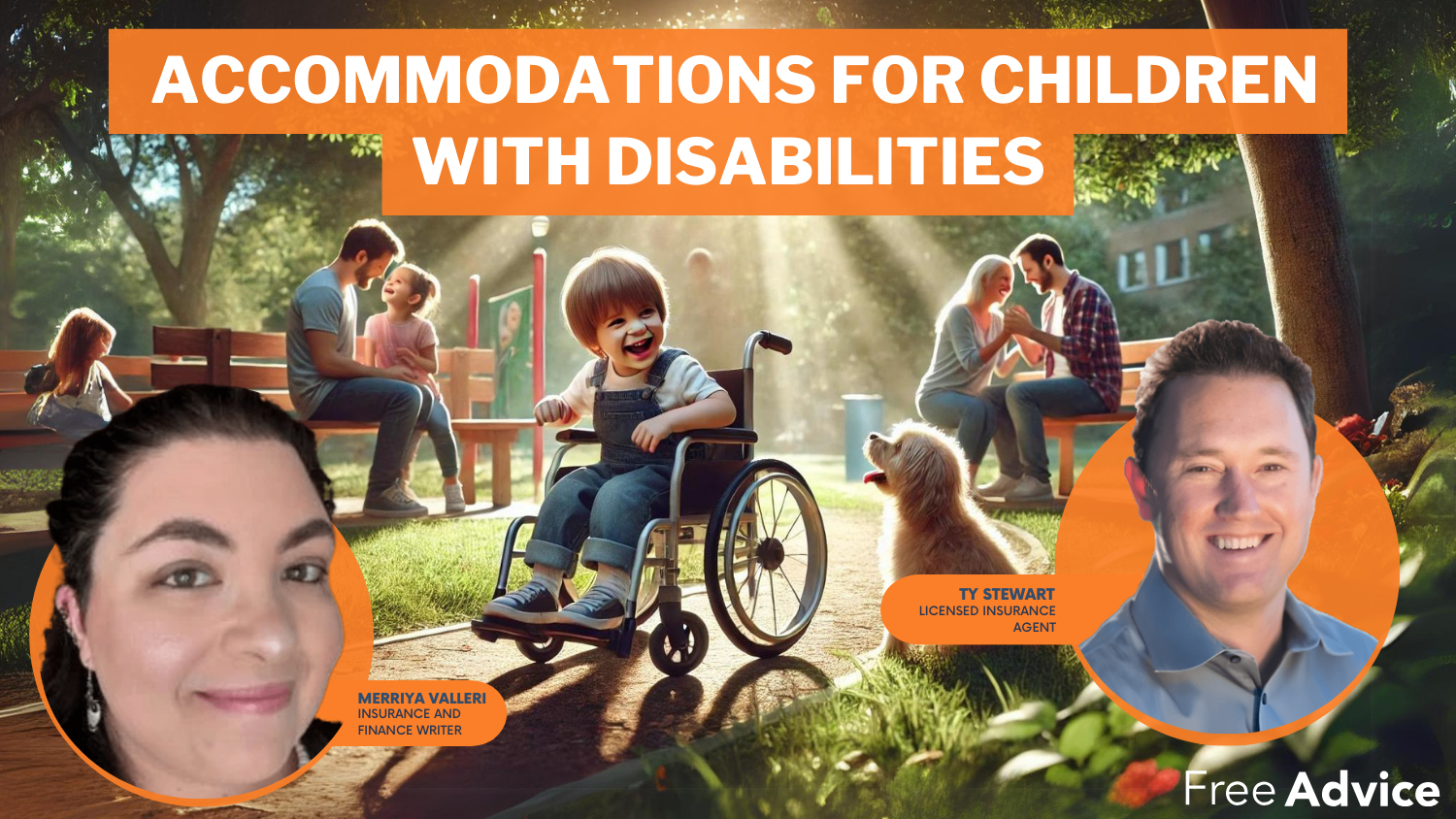
In lunchrooms, there must be wheelchair-accessible tables. In playgrounds, many schools offer specialized equipment so that wheelchair-bound children can use the playground and enjoy their recess freely.
To support students in wheelchairs in the classroom, schools must ensure that classroom layouts are accessible and that all educational materials and activities are adapted to meet their needs.
When you think about What is education law? it covers all of the needs to make sure that every single student has a safe, approachable, and dependable environment to learn.
A well-defined school elevator policy is essential to ensure that students with mobility challenges have access to every floor of the building
Get the Legal Help You Need Now
Connect with Civil Law Experts Today
Transportation for Disabled Children Under ADA Rules
A thorough school wheelchair policy guarantees that students using wheelchairs receive the required accommodations and have full access to the entire campus.
Publicly funded schools must provide a handicap-rigged bus with a wheelchair lift and seats designed to secure handicapped children safely.
These buses must also have space for assistive devices. Furthermore, an adult is required to ride on these buses to assist, supervise, and provide for the care of children on the bus during the trip back and forth to school.
Classroom Setting for Disabled Children Under IDEA
Under the IDEA, students should be placed in a normal classroom setting as much as possible. Any accommodations such as a wheelchair-accessible desk are added to the classroom for the school year. Visual and hearing-disabled students can have adaptive devices in the classroom to make seeing and hearing easier. Textbooks can be ordered in Braille for blind students, allowing them to participate and read along with the rest of the class.
For severely disabled students, schools are required to employ an aide to remain with that child throughout the day. The aid works with the child, freeing up the classroom teacher to do their job. An aide can help the student with their school work and is also responsible for transporting the student for any medical care required at the nurse’s office. Learn more about what legal rights teachers and school authorities have to regulate student conduct.
Physical Education for Disabled Children
If you’re wondering, “Do students have a right to participate in school athletics?“, the answer is that it’s more of a privilege than a right. Physical education teachers are required to create adaptive methods so that students can participate in PE class along with their peers. Accommodating equipment may be used, or a student may be given a specially assigned role such as referee. The goal is to accommodate the students by creating participation at their level of skill so that they may enjoy a typical PE experience.
The Americans with Disabilities Act, active in 1990, is a comprehensive civil rights law that prohibits discrimination against individuals with disabilities. This includes areas of employment, education, transportation, and access to public and private areas.
Rules for Discipline of Children With Disabilities
Disciplining disabled children must be handled with more care and consideration than that of their peers. For example, if a blind student tips over a table with paint on it because they did not realize the table was there, the child will not be punished.
ADA Compliance Requirements by Business Type| Type | Requirement | Description | Compliance |
|---|---|---|---|
| Restaurants | Accessible Entrances & Seating | Restaurants must have accessible entrances and seating for people with disabilities. | Installing ramps, providing accessible seating, and ensuring doorways are wide enough for wheelchairs. |
| Retail Stores | Accessible Aisles & Checkout Counters | Aisles and checkout counters must be accessible to individuals using mobility devices. | Widening aisles, lowering checkout counters, and providing accessible dressing rooms. |
| Hotels | Accessible Guest Rooms | Hotels must provide a certain number of accessible guest rooms based on the total number of rooms. | Providing roll-in showers, accessible room controls, and visual alarms. |
| Office Buildings | Accessible Routes & Facilities | Office buildings must have accessible routes to offices, restrooms, and common areas. | Installing elevators, accessible restrooms, and Braille signage. |
| Public Transportation | Accessible Vehicles & Stations | Public transportation must provide accessible vehicles and stations for individuals with disabilities. | Equipping buses with ramps or lifts, and ensuring stations have elevators. |
| Schools | Accessible Classrooms & Facilities | Schools must ensure that all classrooms and facilities are accessible to students with disabilities. | Providing accessible desks, restrooms, and playground equipment. |
| Parks & Recreation | Accessible Paths, Playgrounds, & Facilities | Public parks must provide accessible paths, playgrounds, and facilities for people with disabilities. | Installing accessible playground equipment, paths, and restrooms. |
In most cases, disabled children are not permitted to be suspended or expelled from school. Instead, disabled children who are acting in disruptive or destructive manners are sent to a temporary isolated class during which time the student’s IEP team determines what to do with the child. The only time a disabled child can be punished just like his peers is for bringing weapons or drugs onto the school campus.
Get the Legal Help You Need Now
Connect with Civil Law Experts Today
School Handicap Accessibility Laws: Getting Help
If you believe that your child’s school has violated the ADA or the IDEA, consider contacting a civil rights or ADA attorney in your area for assistance.
A civil rights attorney can help determine if you have a case and if so, file a lawsuit on your behalf.

Legislation for Accessibility Accommodations
Legislation mandating reasonable accommodations for those living with a disability was mandated to address a long-standing need and pursuance against discrimination and exclusion. Several pieces of legislation encourage those with disabilities to have equal access to opportunities and services in public and private spaces.
Some may wonder, “What legislation requires reasonable accommodations for those with disabilities?”
There are a few pieces of legislation that aid in making sure public and private spaces are accessible to those with disabilities.
For reasonable accommodations:
- Title I (employment) requires that if you are an employer with 15 or more employees reasonable accommodations are made to make areas accessible for those living with a disability.
- Title II (public services) requires that state and local governments, which include public schools, make reasonable accommodations in their programs, services, and activities.
- Title III (public accommodations) requires private businesses and nonprofit organizations that service the public to make reasonable accommodations to ensure that individuals with disabilities have equal access to services and facilities.
Section 504 of the Rehabilitation Act of 1973 is a civil rights law that prohibits discrimination based on disability in any program or activity that receives federal financial assistance, which includes public schools and universities. Under this act, reasonable accommodations require schools and other institutions to provide reasonable accommodations for students with disabilities. This protective law also helps physically disabled children from being harassed in school. This may include making sure there are accessible classrooms, special education services, or individualized education plans (IEPs).
The Individuals with Disabilities Education Act (IDEA) of 1975 is a federal law that ensures that children with disabilities receive free appropriate public education (FAPE).
The Fair Housing Act(FHA) of 1968 prohibits any discrimination in housing based on disability and other protected classes.
The Air Carrier Access Act (ACAA) of 1986 prohibits discrimination based on disability in air travel.
The Architectural Barriers Act (ABA) of 1968 requires that buildings and facilities designed, built, altered, or leased with federal funds be accessible to persons with disabilities.
Who is eligible to attend public schools? The answer is easy: all children. Laws protecting students with disabilities ensure that all students receive equal access to education and necessary accommodations, fostering an inclusive learning environment.
Heidi Mertlich Licensed Insurance Agent
Case Studies: Accommodations for Children With Disabilities & the ADA
Case Study 1: Wheelchair Accessibility in Schools Under the ADA
In this case study, John, a wheelchair user, faces barriers in his school due to the lack of ADA compliance. The absence of an elevator in the two-story building prevents him from accessing certain classrooms and facilities. Sarah, a lawyer specializing in disability rights, helps advocate for necessary accommodations.
Case Study 2: Transportation for Disabled Children Under ADA Rules
Mark, a parent of a disabled child, encounters challenges with transportation provided by the school. The absence of a handicap-rigged bus with a wheelchair lift hinders his child’s commute. Seeking legal assistance, Mark finds support from an ADA attorney to ensure his child’s safety and access to education.
Case Study 3: Classroom Setting for Disabled Children Under IDEA
In this case study, Sarah works with a school to create an inclusive classroom setting for John, a visually impaired student. Accommodations such as adaptive devices and Braille textbooks are implemented to ensure John’s active participation and learning alongside his peers.
Case Study 4: Physical Education for Disabled Children
Sarah collaborates with Mark, a physical education teacher, to develop adaptive methods for Sarah’s child, who has limited mobility. By providing accommodating equipment and assigning specialized roles, Sarah’s child can actively engage in physical education classes and enjoy a fulfilling PE experience.
Case Study 5: ADA Rules for Discipline of Children With Disabilities
John, a student with autism, faces disciplinary challenges due to his disability. Sarah, his advocate, emphasizes the importance of handling discipline with care and understanding. Together with the school’s IEP team, they developed a supportive approach tailored to John’s needs, ensuring fair treatment and promoting a positive learning environment.
Frequently Asked Questions
Are schools required to have an elevator?
The Americans with Disabilities Act (ADA) requires that public buildings, including schools, be accessible to individuals who are living with disabilities. There are some nuances based on the age of the building. Schools built after 1990 are required to be fully accessible, which usually includes the installation of an elevator. Older schools may not be able to undergo a renovation to add in an elevator but they may have to be creative in finding alternative ways to make all programs and services accessible to those living with a disability.
Do public schools have to be ADA-compliant?
Yes, public schools in the United States are required to be compliant with the ADA. The ADA is a civil rights law that prohibits discrimination against individuals with disabilities in all areas of public life, including public schools. ADA requirements are applicable in all fifty states. Who is responsible for the public school system? The government is.
Do schools have to be wheelchair accessible?
Yes, under the ADA federal law and Section 504 of the Rehabilitation Act of 1973, schools in the United States are required to be wheelchair accessible. Laws for wheelchair accessibility mandate that public buildings and facilities, including schools and businesses, must be equipped with features like ramps and elevators to ensure that individuals with mobility challenges can access them safely and independently.
What is not considered an ADA accommodation?
An ADA accommodation refers to any modifications or adjustments that aid individuals with disabilities to have equal access to employment, public services, and facilities.
Some examples of accommodations that are not required by the ADA are the elimination of essential job functions, providing personal items such as hearing aids, wheelchairs, or glasses to aid on and off the job, and finally, any accommodations that aid in undue hardship.
Is anxiety covered under the ADA?
If a person’s anxiety disorder significantly impairs their ability to perform major life activities, it may be considered a disability under the ADA since by their definition it meets the criteria of a disability. If an employee or student has a qualifying anxiety disorder they may be entitled to reasonable accommodations.
What is considered a violation of the ADA?
A violation of the ADA happens when a disability is subjected to discrimination or is denied access to opportunities, services, or facilities, and when reasonable accommodations are not provided as required. What laws protect physically disabled children from harassment at school? While we never hope for a situation like this, several existing laws help protect children at schools.
What is the most overlooked disability?
The most overlooked disabilities are the invisible ones, like mental health disorders, chronic pain and fatigue conditions, learning disabilities, neurological disorders, hearing and vision impairments, autoimmune disorders, and traumatic brain injuries (TBIs).
What is the most commonly approved disability?
The most commonly approved disabilities include musculoskeletal disorders (severe arthritis, degenerative disc disease, spinal disorders), mental health disorders (depression, anxiety, bipolar disorder, schizophrenia), cardiovascular disorders (congestive heart failure, coronary artery disease, chronic heart failure), respiratory disorders (COPD, severe asthma, pulmonary fibrosis, neurological disorders (epilepsy, multiple sclerosis, Parkinson’s disease), cancer, autoimmune disorders (lupus, RA, Crohn’s), and diabetes-related complications.
What are the 3 C’s of accommodation?
These are three key principles to consider when providing accommodations for individuals with disabilities. They are communication, collaboration, and consistency. The school districts are committed to providing special education and the equal rights of the disabled to equal access in all academic, programs and activities.
What are examples of accommodations and modifications in an IEP?
These are accommodations designed to support students with disabilities in their educational environment. It could mean extended time for a presentation, larger print materials, alternative test formats, a quiet room for testing, the use of technology for means of communication, or alternative goals and ways to present assignments.
What are 5 things that the Americans with Disabilities Act covers?
Is ADHD a disability under the ADA?
Can ADA accommodations be denied?
Are there any limitations to accommodation under the ADA?
What law requires elevators in schools?
How do schools accommodate students in wheelchairs?
Related Articles
-
Jan 2025

Can you get a refund on a used car if defects are found after purchase? (2026 Auto Laws)
-
Jan 2025
Can staff require a student to stay on campus after school hours? (2026 Legal Answers)
-
Oct 2024
Landlord’s Duty to Maintain Pipes and Plumbing
-
Sep 2024
Arrest Based on Rape Accusation in #current year (Navigating the Legal Process)
-
Jan 2025
Can I still collect child support arrears after my child turns 18? (2026 Laws)
-
Jan 2025
Can my employer treat me differently than other employees? (2026 Legal Answers)




Get the Help You Need Today
Get free insurance quotes or connect with legal experts in minutes